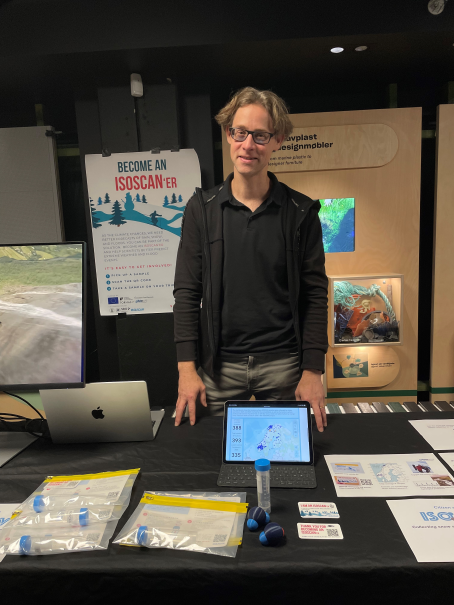
Harald Sodemann at the ISOSCAN stand at VilVite
Forskningsdagene is an annual outreach event where research and the public get in touch about science. This year, University of Bergen arranged for the first time the ‘Researcher’s night’ at VilVite on 25 September. Aiming for young adults, mostly students, the evening arrangement featured a podium discussing about AI and other current societal topics, a show with fancy experiments and explosions, and stands from different research and innovation activities around Bergen.
The ISOSCAN project contributed with a stand, showcasing our overall approach and outreach materials, including the recently released ISOSCAN movie. This is part of ‘giving back’ to the citizen scientists who collected snow for the project last winter. There were quite a few engaged and curious young adults at the stand, some of them even noticed the sample kits that were distributed among others in Realfagbygget.
As a takeaway from participating in the Researcher’s night, it became obvious that it is easy to get into a conversation with the public about a topic as remote as streamflow prediction improvements due to stable isotopes in snow though the materials and stories developed within the ISOSCAN project.
Text and photo: Harald Sodemann / UiB