
The overall aim of the ISOSCAN project is to generate a large amount of water isotope data using both conventional and novel approaches, such as citizen science. To this end, the project is developing a scalable citizen science framework involving recreational nature users (both locals and visitors) as well as tourism, leisure and other stakeholders. This work has involved not only the entire project team, but also hundreds of citizens, primarily in the Tromsø area of Norway, as well as in other parts of Norway, Sweden and Finland.
After two years of working on the project, ISOSCAN had produced a great deal of knowledge through an iterative co-design process involving various groups of stakeholders. In February and March 2026, we presented our findings at three major conferences, which were attended by researchers and practitioners from various relevant fields, including citizen science, Arctic observations, and other industries and fields in the Arctic region.
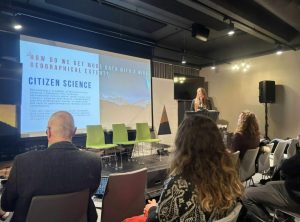
Ann Eileen Lennert presenting at Arctic Frontiers in Tromsø, Norway
First, in early February, Ann Eileen Lennert (UiT) represented ISOSCAN at the 2026 ARCTIC FRONTIERS conference in Tromsø with a talk on “Scale, Engagement, and Data Quality in Arctic Snow Sampling”. This international event hosts high-level conversations with leading Arctic stakeholders, including scientists, and covers topics from all corners and sectors of the Arctic. Delivered at the session on “Maintaining and Developing Arctic Observing Capabilities”, Ann Eileen’s presentation focused on the lessons learned from testing the ISOSCAN citizen science concept, which included the ISOSCANer Kit, webform, and website in April 2025. The presentation touched upon the improvements that the ISOSCAN science campaign of 2026 would have as a result of the testing, as well as emphasising the need to consider the various interests and needs of those involved in the process, including different scientists, citizen scientists, and institutional actors.
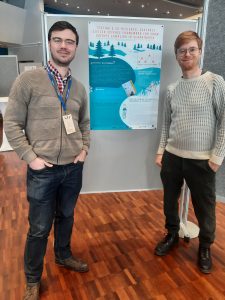
Kristof Tomej and Pertti Ala-Aho with the ISOSCAN poster at the ECSA 2026 conference in Oulu, Finland
In early March, Kristof Tomej (SDU) presented a poster titled “Testing a co-designed, scalable citizen science framework for snow isotope sampling in Scandinavia” at the 2026 ECSA (European Citizen Science Association) conference in Oulu, Finland. Over 600 citizen science practitioners and researchers from around the world attended the conference. The ISOSCAN poster showcased the experiences of a scientist-driven citizen science project. The conference provided an opportunity to share experiences with other projects, particularly those involving water, snow, or the collection of physical samples. The conference also enabled a brief but enjoyable meeting with ISOSCAN team members Pertti Ala-Aho and Charlotte Ditlevsen from the University of Oulu.
Lastly, on 30 March, Eva Duedahl and Kristof Tomej, both from SDU, were invited to present at the Permafrost Shared Arctic Variable (SAV) session at the Arctic Observing Summit (AOS 2026). The summit was held as part of the Arctic Science Summit Week (ASSW 2026) in Aarhus, Denmark. The presentation, titled “Bridging Arctic Data Gaps Through Co-designed Citizen Science: The ISOSCAN Experience”, was based on an openly accessible short paper of the same name submitted to the summit.
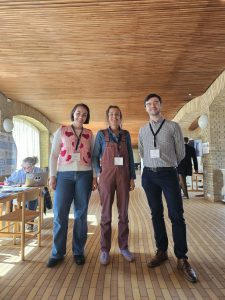
Eva Duedahl, Ann Eileen Lennert and Kristof Tomej at the Arctic Observing Summit in Aarhus, Denmark
The presentation allowed for dialogue and learning across the fields of hydrology, permafrost and citizen science. Eva and Kristof provided more detailed insights into the iterative co-design process in ISOSCAN and the challenges addressed, while learning more about inclusive permafrost monitoring approaches and the integration of scientific and indigenous knowledge systems in the Arctic.
The three conferences are just one part of ISOSCAN’s communication and dissemination activities, as our project members regularly give presentations to both scientific and non-scientific audiences. We are also working on multiple publications for scientific journals and preparing a science communication event for later in the year.
Text and photo credits: Kristof Tomej